Showing posts with label Main Street U.S.A.. Show all posts

Tuesday, September 10, 2024

Comparing every Main Street U.S.A.


1. DISNEYLAND

MAIN STREET U.S.A. - OPENED: JULY 17, 1955

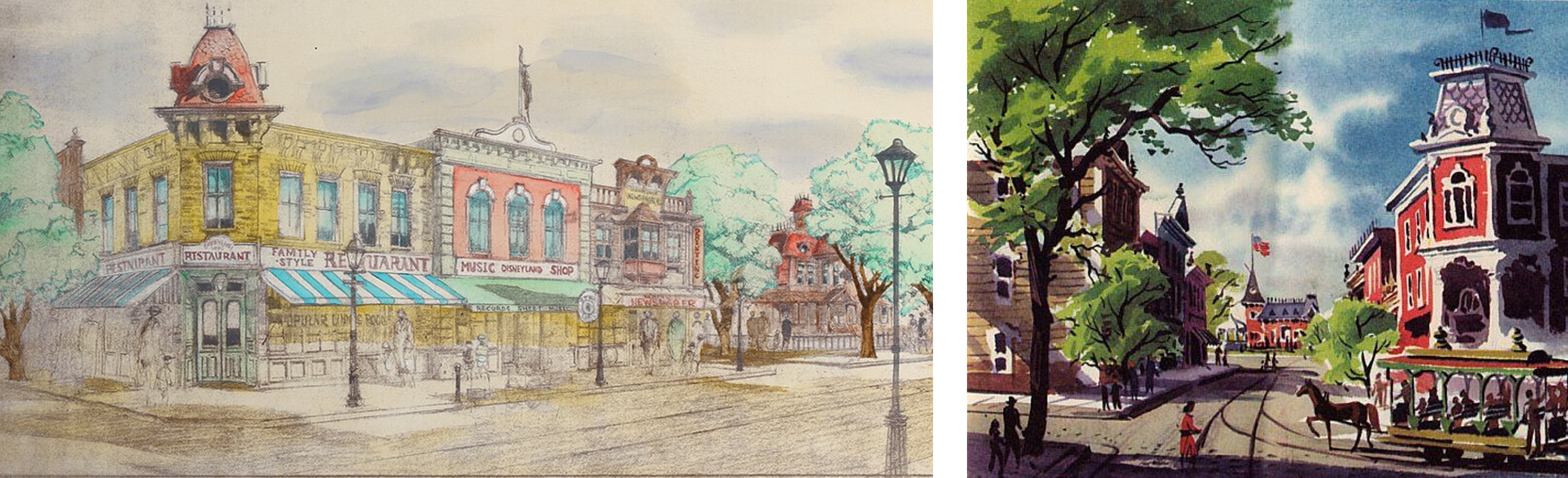
Main street U.S.A. opened as one of the five original lands of Disneyland. Walt Disney’s idea was to create a peaceful entrance: ‘scene one’ of his lavish cinematographic theme park. This street could basically serve as a movie set, with this difference that the buildings here are not mere façades. Here, you can go inside, feel it, and take in the smell of the place. This is a themed environment serving as background setting in which guests are immersed into a different world. And so, Walt created a ‘theme park’, a new and groundbreaking approach in the amusement park business.

This street was envisioned as an idealized version of Walt’s childhood hometown Marceline, Missouri at the turn of the century (1900-1910). This was a peaceful period and would work well in ‘The Happiest Place on Earth’. Apart from the Zurcker building that inspired the Refreshment Corner Café on Main Street, Marceline was more of a childhood memory, rather than the real basis for Main Street. Harper Goff, who drew most of the artwork, said much of it was based on pictures from his own hometown Fort Collins, Colorado. Many resemblances can be seen in buildings like Hottel House, the Old Main, and the Firehouse. Carnation Café is based upon the former Poudre Valley Bank of Fort Collins. The Plaza Inn restaurant on the hub has a slightly different theming, more flamboyant Victorian, similar to the Valley Knudsen Garden Residence in Los Angeles and actually more in line with Magic Kingdom’s Main Street design. Disneyland’s City Hall is probably based on a picture of Bay County Courthouse in Bay City. This was found in one of the many books on American Victorian architecture that were used as reference too.

© Disney
To create an intimate look, all the ground floors are built at 7/8 size, with the upper floors even smaller in proportion. This practice is known as forced perspective. It is used throughout the park mainly to create a charming not-quite-real feeling.

As Walt had a passion for miniature trains, a working steam train was included in the creation of his theme park. The entrance building to his park is also the main station of the Disneyland railroad. It has a typical 2nd Empire style like the demolished Union Depot in Kansas City. Once passed the station you arrive at Town Square. Here you find the City Hall and the revolutionary at the time attraction: Great Moments with Mr. Lincoln. This attraction got a permanent installment in Disneyland after its success at the 1964 New York World's Fair. In the middle of Town Square, a gazebo was built, then demolished, and relocated next to the castle before the opening of the park, since it blocked the view to the castle too much.
© Disney
Straight ahead runs Main Street for 2 blocks to the central hub, just in front of the castle. Main Street features a variety of shops, restaurants, and entertainment. The rather small-scale attractions all contribute to the atmosphere created here. They include Main Street Vehicles, Horse-Drawn Streetcars, Main Street Cinema, and the not-to-be-missed Barbershop Quartet. Furthermore, the street is used as setting for the famous Disney Parades. 

The beauty and charm of this land sets a very high standard for the following parks. Disneyland’s Main Street U.S.A. is the textbook example of the difference between a theme park and an amusement park.


2. MAGIC KINGDOM

MAIN STREET U.S.A. - OPENED: OCTOBER 1, 1971

Prior to opening Walt Disney World, market research showed that Magic Kingdom was to accommodate a larger number of guests. The park needed to be bigger than Disneyland, so the Imagineers stood before a challenge: how to create a bigger Main Street without losing the charm and intimacy of it? Their answer was to make the buildings taller but maintaining the forced perspective. The 1900s era stayed, but the town became a more elegant Victorian east coast city, with its façades resembling the prosperous Saratoga Springs in New York. It features a more decorative style including French mansard roofs, heavier moldings, and lavish porches, like the Victorian buildings of Saratoga Springs (e.g., the United States Hotel, The Batcheller Mansion, Nolan House and houses on Greenfield Avenue and Regent Street). They also used more vivid colors like the red colored sidewalks. This shade supposedly absorbs the bright Florida sunlight rather than reflect it and this is the perfect background color to make photographs (with the castle in the distance) ‘pop’.

© Disney
Many of the corner buildings have typical Queen Anne style octagonal towers (compare the Plaza Ice Cream Parlor with South Carolina’s Davis House). The four buildings on the crossing of Main Street and Center Street reflect four slightly different styles: New England, Chicago, New Orleans, and New York City. Palmer House Hotel in Chicago is likely the inspiration for the Disney Clothiers façade, and Uptown Jewelers combines the typical 2nd Empire mansion style with New Orleans Ironwork.

The impressive Main Street Station serves as entrance building to the park and is based on the Saratoga Depot in Saratoga Springs. It is the most majestic of all Disney train stations. On Town Square, Main Street Theater is based on the United States Hotel also in Saratoga Springs. The City Hall is inspired by the one in Philadelphia, and The Firehouse is like Nuppenau House in Detroit in Gothic Revival style. The Emporium’s grand porches are based on those from the Tampa Bay Hotel. Instead of the Plaza Inn Restaurant, the hub here has the Crystal Palace Restaurant, styled like San Francisco’s impressive Victorian Conservatory of Flowers greenhouse.

Inspiration also came from the 1969 movie version of the musical Hello Dolly set in 1890’s New York. The film’s Oscar winning production designer was John DeCuir, who subsequently worked on the design of Magic Kingdom. The similarities are undeniable, from the Victorian façades to even the benches. The overall result is an elaborate street with higher buildings, more depth, and in harmony with the bigger and more detailed castle.

© Disney
Since Magic Kingdom is a grander park, it is often thought that Main Street is longer too, but this is not the case. The street is almost the same in length and just a little wider than its sibling. The hub is bigger though, designed to master heavier crowds. When you enter the park and look at the castle, it seems far away. This is a perspective trick: by making the buildings near the end of Main Street a little higher and the porches placed a little more towards the center, everything is building up to the castle in the distance. But now, when you are at the hub looking the other way towards Town Square, it works in reverse. The buildings nearest to you are big, making the rest of the street seem smaller and the exit nearby. Off course this is no coincidence, the idea is that people in the morning are fresh, overwhelmed, and willing to walk and discover the park. But at the end of the day, when people are tired, they just want to go to sleep and do as little walking as necessary. This effect is enhanced by the fact that the street runs slightly uphill towards the castle.

This land features less attractions than Disneyland’s, but the key ingredients are all present: Main Street Vehicles, Horse-Drawn Streetcars, the Barbershop Quartet, and the parades. Some earlier attractions, like the cinema and the arcade, have become retail space. Magic Kingdom does have one new attraction: a real Barbershop, originally located on West Center Street (the side street to the left). In 2001 this street was replaced by a shop too. Thematically, this is sad since Center Street offered a beautiful and unique quiet spot on the often-crowded Main Street. Luckily East Center Street stayed, and the Barbershop was relocated to Town Square.

All in all, Magic Kingdom’s Main Street is a lavish street. Less cozy and charming as Disneyland’s, but more detailed and overwhelming.


3. TOKYO DISNEYLAND

WORLD BAZAAR - OPENED: APRIL 15, 1983

For Tokyo Disneyland, the Imagineers wanted to create a brand new ‘land’ and not a mere copy of Main Street. The early concepts by artist Herbert Ryman show a contemporary multileveled concourse protecting guests from the heavy rainfalls during winter, called World Bazaar. This new land would be themed as an international shopping and dining street. Unfortunately, this did not happen because the Oriental Land Company (Disney’s Japanese partners) wanted nothing new. They wanted the best of Disneyland combined with the best of Magic Kingdom as an ‘improved Disneyland’. Main Street was back on the table, but the name World Bazaar, and the fact that the street would be covered stayed.

© Disney
The façades are mostly based on Magic Kingdom’s version, although with less porches (they became redundant with the large canopy). Some façades are new and unique, influenced by the Art Deco period. The canopy is themed as a Victorian iron-and-glass exhibition hall not unlike the World Exhibition buildings of 1889 in Paris and 1897 in Brussels. At the exit of the canopy towards the hub Magic Kingdom’s Emporium façade, with its octagonal corner porch, is doubled to create an impressive, symmetric gateway. On the right side of this sits a completely new building, the Sweetheart café, in whimsical Queen Anne style, including a turret with an onion dome. On the left side sits the Home Store, also with a new and unique Victorian façade, making the back side of World Bazaar the most interesting and beautiful representation of the theme. Furthermore, the hub features a carbon copy of Magic Kingdom’s wonderful Crystal Palace (although here it is considered a part of Adventureland), and one attraction: the Omnibus.

Center Street is interesting too, it is wider and gives access to Adventureland to the left and Tomorrowland to the right. A clever thematic trick was applied: the façades towards Adventureland feature New Orleans influences. In this park Adventureland includes a New Orleans section right next to World Bazaar (see separate comparison). That is why the architecture of Magic Kingdom’s Uptown Jewelers is used for the Great American Waffle Co. restaurant. On the other side, towards Tomorrowland the exit features angular Art Deco shaped elements, oddly working well as transition towards the clean lines of Tomorrowland. The exterior here is kept quite minimalist and works well too, except for the out of theme Post-Modernist façade of Toy Station. It doesn’t fit the Victorian era but is luckily a quiet spot in the park.   

© Disney
Although the buildings and the canopy reflect the same period, something is off here. It feels more like an ‘American Pavilion’ at a World Fair rather than an actual recreation of an American street. A real street has no roof. And since themed attractions like Main Street Vehicles, Horse-Drawn Streetcars, and even the Railroad are missing here, it is difficult to get immersed into this version of a 1900s American town. Maybe International Street might have worked better under the canopy, for this would fit the theme of a 1900s exhibition hall. On the other hand, it is an extremely practical structure: not just as shelter, but also to get around in the park. This is the only park where Center Street gives access to both adjacent lands. Also, it is the main shopping area of the park, and shopping is a traditional must for the Japanese guests. Doing this protected from the rain is quite valuable here. The Hub is also unique and even bigger than Magic Kingdom’s, with a circular ‘street’ around it for the flux of people and for the parades.

© Disney
World Bazaar is an interesting variation on an American turn-of-the-century town. Every individual aspect of this land is representative of 1900s Western architecture. For someone who grew up in Europe or America, this version does not create the illusion of an actual street. But for the Japanese guests there is no comparison, and so World Bazaar actually works quite well here.


4. DISNEYLAND PARIS

MAIN STREET U.S.A. - OPENED: APRIL 12, 1992

Like Tokyo’s version, the original plans showed a canopy for the European version, and a completely new Art Deco styled street influenced by the jazz era and Hollywood’s roaring twenties. It would feature big and innovative attractions adapted to this period and an elevated tramway, like the one from the movie Hello Dolly. Eddie Sotto, artistic director for Main Street in Europe, explained that the idea was to reflect an American style period that fascinated Europeans. The Imagineers were in serious doubt whether the guests here would relate to, or even appreciate a Victorian American town. Then again, changing everything and applying something completely new was maybe even more risky. Michael Eisner finally vetoed the 1920s approach, and the 1900s Main Street was back, with some minor 1920s influences though. To appeal to the European guests, this Main Street was designed without the canopy, but with many layers and details, to show the rich history of the town.

The façades of the street are for the most part the same as in Magic Kingdom, but with an expanded color palette, based on Disney’s 1955 animated movie Lady and the Tramp. Another novelty is the meticulous care for detail especially of the interiors. Center Street here is split it 2 separate streets named Flower Street (to the left) and Market Street (to the right). Flower Street features Walt’s Restaurant, based on Disneyland’s Club 33; Liberty Court, a small unique attraction making a connection between France and the USA; and a Barbershop too. Market Street has the unique Main Street Motors on its corner, featuring 1920s styled Times Square billboards. Furthermore, Market Street was inspired by San Francisco’s 'painted ladies' style and serves as a good example of the richness and the use of softer and more elaborate colors than in Magic Kingdom.

© Disney
Town Square is different than the previous versions, it has more of a 1900s New York vibe. The buildings here are not as big as Magic Kingdom’s, but bigger and more detailed than Disneyland’s. City Hall is inspired by New York’s Western Union Telegraph building and has a unique arboretum to the left. To the right there is the Storybook Store, based on the library from the movie musical The Music Man. The unique octagonal Victorian gazebo in the middle of Town Square is similar to the bandstand depicted in the book 100 Victorian Architectural Designs by A. J. Bicknell. It blocks the view to the castle on purpose because the Imagineers wanted guests to experience Main Street before being drawn to the castle. The block on the right side of Town Square, with the striking Transportation Company building in the middle, has a silhouette based on Disneyland’s Sleeping Beauty Castle, but in a unique Victorian style.

Instead of a covered street, two arcades stretching from Town Square to the hub protect guest from the inclement weather. Again, they are beautifully designed as 19th century shopping arcades like the Burlington in London, giving access to all the shops and restaurants from the back. They are found in every major city in Europe, so by adding these arcades another local connection was made. Thematically they both have a link to the land next to it: Liberty Arcade, leading to Frontierland and Discovery Arcade leading towards Discoveyland. Apart from these arcades, all the classic Main Street attractions are present.

The Victorian Disneyland Hotel serving as entrance gate instead of the typical train station, is a completely new idea. The pink color reflects the color of the castle. To avoid blocking the panoramic view from the hotel over Main Street, the station (which sits behind the hotel) was made significantly lower. It is designed as a Victorian wood depot, with staircases inspired by those from New York’s elevated Train Stations and floors paved with English encaustic tiles, all typical for the period.

© Disney
Finally, this street is paved with bricks, laid out in a pattern like in New York City at the turn of the 20th Century. They are also red colored like the sidewalks in Magic Kingdom, but here the tone is softer and shows more variation because of the small differences between the bricks. This makes another connection to Paris and other European cities, often having bricks or cobblestones instead of grey tarmac.

Every detail, every layer, and every single aspect of this land is designed to perfection. Although there are no real rides to be found, still the European guests love to spend time here, exploring all the richness and beauty of this land.


5. HONG KONG DISNEYLAND

MAIN STREET U.S.A. - OPENED: SEPTEMBER 12, 2005

Hong Kong Disneyland’s Main Street is based on Disneyland’s original version. Most of the façades are carbon copies. But the use of vivid colors here is quite different from the California counterpart with its softer, more realistic colors. This street is a little wider too and has red colored bricks, like in Paris. The color of the bricks is much more vivid and prominent here. These bricks are not altered by the tracks of the Horse-Drawn Streetcars since this Main Street classic is the one attraction most notably missing here.

© Disney
The backstory of Immigrants nestling in a small Midwest American town is exclusive here. It features some unique experiences like Art of Animation, which houses in Disneyland’s building for Great Moments with Mr. Lincoln, and Animation Academy, right next to it. Although it is nice to have some change in attractions, these ones fit better in a different environment, like a Disney Studios theme park.

© Disney
Overall, this Main Street is beautiful, but the bright colors, and the lack of attractions, cause this street to fail to immerse its guests like the original in Anaheim does. But, just like World Bazaar works very well in Japan, this whimsy version of Main Street works perfect for the local guests in Hong Kong too, not having the real thing to compare with in the first place.

The original plans showed a more unique approach, without a railroad, but with canals surrounding the hub and a large lake right next to Main Street, which would feature the spectacle: Fantasmic! Many budget cuts were made, and the park was scaled down. The new ideas for the park and for Main Street disappeared. The result is still nice but, compared to the other versions, it is hard to ignore something is missing here.


6. SHANGHAI DISNEYLAND

MICKEY AVENUE - OPENED: JUNE 16, 2016

Main Street is called Mickey Avenue here, the hometown of Mickey Mouse and his friends according to the original background story. Visually, it is a combination of Toontown with Victorian, Edwardian, and even French 1900s architecture, keeping the functionality of a classic Main Street. It pays tribute both to famous and lesser-known Disney characters from Walt Disney’s original 1940s and 1950s movies and shorts. Ratatouille, a more recent movie from 2007, is also included. On Tim Delaney’s website there are many early proposals to be found including a Hollywood themed street, a Forest Village, or a Whimsy Street. One proposal, closer to the final version, included buildings from famous movies like Aladdin, Mary Poppins, and Peter Pan. From the beginning it was clear that Shanghai was to be a different kind of ‘Castle Park’, and it is. Most probably, this approach was chosen to avoid the same problem as in Tokyo and Hong Kong, where the Western Main Street is too far away culturally to relate to. Although this street is a bit of an architectural mishmash, it works quite well as a new ‘land’ with subtle references to many Walt Disney movies and shorts. It is divided in 4 small neighborhoods.

© Disney
The grand entrance building is designed as a typical train station, although there is no railroad here. Right behind it is the first zone: Celebration Square, taking the spot of the typical Town Square. This is the biggest and most important of all neighborhoods. On the right is the post office and the Carefree Corner, reminiscent of the octagonal corner of the Glendale Sanitarium in California in Victorian style. Next to it is the Minnie Mouse themed Sweethearts Confectionery in Queen Anne Style, like the Purple House in Ocean Grove.

On the opposite site sits the rather small City Hall, right behind the entrance. It has a unique Romanesque design like a small church, including a typical bell tower. Avenue M Arcade is the largest shop here, replacing the traditional Emporium. The main entrance resembles an Edwardian Baroque theater façade in the style of Willian G. R. Sprague, the famous architect who is responsible for many London theatres in the 1900s. The other big entrance to the shop is a replica of the 1926 Carthay Circle Theater in Los Angeles in Spanish Colonial style, famous for hosting the premieres of many Disney movies. This shop has many more other façades, introducing many different architectural styles, mostly inspired by the cartoons they represent, including Mickey shorts like Magician Mickey and Clock Cleaners, the Silly Symphony Music Land, and the film Melody Time.

The Second area is the small Park Place just in front of the Gardens of Imagination. Here is Remy’s Patisserie based on the Ratatouille movie, introducing Pixar to the theming, and adding typical Parisian Haussmann architecture to the design. Park Place creates a smooth transition between Mickey Avenue and the adjacent Gardens of Imagination.

© Disney
Right next to it lies Market District, the third area with an overall American warehouse style. Most notably here is the large Market Café and the Whistle Stop Shop, themed as a Victorian train station. The architecture of the latter is a close copy of the Point of Rocks train station in Maryland in Gothic Revival style. The backstory explains this is the former train station, now used for retail. 

The Theatre District is the fourth neighborhood and lies on the other side, leading towards Tomorrowland. Mickey's Storybook Adventure is found here. This show actually takes place in the Art Deco styled Walt Disney Grand Theatre in Downtown Disney right next to the park. It also features the Venetian styled Il Paperino ice cream restaurant with a Donald Duck theming.

Although there are no actual attractions here (apart from the aforementioned show), the land works quite well. The cartoonish theming makes it perfectly possible to have many different styles eclectically combined. It even creates an immersive feeling, which is somewhat missing in the two other Asian parks.


(click image to enlarge)

FINAL THOUGHTS

Shanghai’s cartoonish approach is definitely unique and appealing, although it lacks the stylish beauty of a ‘classic’ Main Street. The intention of the World Bazaar design in Tokyo is good, but the canopy makes it anyhow quite impossible to create the illusion of an actual street.

Hong Kong’s street is designed as a charming small Midwest town, almost identical to Anaheim’s original version. The difference is that the latter feels more real and has more to offer attraction-wise, making it a tinge better.

The grander streets of Paris and Florida are almost identical too, Town Square is different though: Saratoga Springs inspired in Florida and New York City inspired in Paris. The meticulous care for detail, the two beautifully crafted arcades, and both Flower Street and Market Street, make Paris stand out.

BEST MAIN STREET U.S.A.: Disneyland Paris (but Anaheim comes close)

Tuesday, March 21, 2023

Comparing the 6 Castle Parks - part 1


GENERAL COMPARISON OF THE PARKS


1. DISNEYLAND

OPENED: JULY 17, 1955

Creating a place where adults and children could have fun together. This was Walt Disney’s initial idea, eventually becoming Disneyland. The first plan was a much smaller park adjacent the Disney Studios in Burbank called Mickey Mouse Park. At first the Burbank City Council voted in favor of this park, but as the idea grew bigger, the final proposal was rejected in 1952. The council did not want a dirty amusement park attracting ‘the wrong kind of people’. (After the war, many amusement parks were left neglected like Coney Island for example). So, Walt set out to find a new location and purchased the affordable 160-acre orange tree orchard in Anaheim. At the time, few people believed Disneyland would be successful. It was difficult to convince people that his park would not be an amusement park, but a completely new type of experience: a theme park. It did not help that his park was situated in the middle of nowhere. As was often the case, Walt was right, his park would become a success and it would be the first of many Disney parks around the globe.

Disneyland’s easy-to-understand wheel and spoke lay-out is one of the most genius theme park design elements Walt came up with. Any guest can easily return to the hub at any given time to get orientated and decide which one of the five lands to visit next: Main Street U.S.A., Adventureland, Frontierland, Fantasyland or Tomorrowland. The names are chosen to be clear and simple so guests can assume what is to be found inside each land. In the earliest drawings, the park featured more lands including Holiday Land and Lilliputian Land, but these were scrapped. Holiday Land did open in 1957 and closed 4 years later in 1961.

Over the years four additional lands opened: New Orleans Square in 1966, Bear Country in 1972 (renamed Critter Country in 1988), Mickey’s Toontown in 1993 and finally the Star Wars based Galaxy’s Edge in 2019. Today, Disneyland has 9 themed lands, featuring over 60 attractions, more than any of the other Disney parks.


2. MAGIC KINGDOM

OPENED: OCTOBER 1, 1971

When Walt Disney unveiled plans for what was known as “The Florida Project” by insiders, his initial goal was to create a real living city with transportation and design elements way ahead of its time, known as EPCOT: the Experimental Prototype Community of Tomorrow. But after his death in 1966 the Disney company was struggling to create this massive project. Finally, it was Roy Disney, Walt’s brother who led the company to create Walt’s biggest dream anyway. Instead of taking the risk of opening the enormous and expensive EPCOT, they chose to open Magic Kingdom, a safer choice since it was based of the highly successful Disneyland.

The biggest issue was space. Walt was frustrated that he could purchase only 160 acres of land in Anaheim and to his dismay his park became boxed in with cheap hotels and retail spaces popping up around it. That is why The Disney Company secretly bought a total of 27000 acres of land in Florida. This time the surroundings would be filled with Disney’s own choice. A theme park surrounded by themed hotels, recreational areas, lakes and so on. Assured nothing unforeseen might pop, they also kept open spaces or natural elements in-between each location. The theme park itself would also be bigger. The innovative design of Disneyland was perfected in Florida for Magic Kingdom is designed to handle more crowds, with bigger walking paths and more open space. And there would be plenty of room left for expansion.

In the earliest drafts the park featured seven themed lands. The five Disneyland originals: Main Street U.S.A., Adventureland, Frontierland, Fantasyland and Tomorrowland. With Liberty Square, a replacement for New Orleans Square, and Holiday Land added. The latter would be dropped and so Magic Kingdom opened with six themed lands. In 1988, to celebrate Mickey’s 60 Birthday, a special temporary land was added: Mickey’s Birthdayland. Because of its success it became a permanent land, it was renamed Mickey’s Starland in 1990 and Mickey’s Toontown Fair in 1996. It closed eventually in 2011 to make place for the area Storybook Circus in the New Fantasyland, that opened in 2012.

Magic Kingdom opened as a part of the Walt Disney World Resort, together with two hotels, two golf courses and the monorail. Later that year a campground and some key attractions in the park like Peter Pan’s Flight, Submarine Voyage and Flight to the Moon opened.


3. TOKYO DISNEYLAND

OPENED: APRIL 15, 1983

Tokyo Disneyland was the first Disney park to be constructed outside the US and the first to be owned by another company: The Oriental Land Company (OLC), licensing the themes from The Walt Disney Company. It was the OLC that came to Disney with a proposal to build a theme park in Japan. Disney was intrigued and at the same time worried. They questioned the weather and how to adapt the park to the Japanese guests. Furthermore, being occupied with the construction of EPCOT in Florida they said no at first. OLC proved persistent and convinced Disney by assuring the weather would not be a problem if the park was done properly. They also assured that no cultural adaptations were needed, people would come for the simple fact that it was so American. The OLC would finance everything, while Disney would be in control creatively. The deal was signed eventually, and construction began in 1979.

One inspirational painting by Herbert Ryman showed Space Mountain to the left of the castle rather than the typical right side. Interestingly, an early lay-out of the park showed Tomorrowland indeed on this spot and Adventureland and Frontierland on the other side. This plan also introduced a sixth land: International Land, a miniature version Epcot’s World Showcase, not to be confused with World Bazaar. The latter would be a contemporary international shopping and dining street, much bigger than the current version, including entertainment facilities, designed to be able to operate independently of the other lands. For they would close if the weather was bad. Although, these ideas may seem interesting and renewing, OLC made it clear to copy as much as possible from the existing Disneyland and Magic Kingdom parks. The result was a park with clones from the best attractions of both parks. The total cost of the project ran up to 180 billion yen against a budgeted 100 billion yen. OLC’s President Takahashi made it clear to build the real thing without compromises.

The biggest difference in lay-out is the huge hub and the large walking paths throughout the park. There is open space to be found everywhere. This was chosen as a striking difference between the density of Japan, and Tokyo in particular. Guest come to the park for leisure, it had to have a relaxed atmosphere.

On opening day, Tokyo Disneyland consisted of five themed lands: Adventureland, including a small New Orleans area, Westernland, Fantasyland, Tomorrowland, and World Bazaar. The latter resembling Main Street U.S.A., but with a giant canopy over it. Disneyland clones of Critter Country and Toontown were added in 1992 and 1996 respectively.

A change of strategy occurred most notably with the opening of the resort’s second gate: Tokyo DisneySea, a completely unique and extremely detailed park, featuring no cloned attractions whatsoever. Tokyo Disneyland too, would welcome some original attractions and additions including the unique Beauty and the Beast themed expansion of Fantasyland in 2020.


4. DISNEYLAND PARIS (opened as EURO DISNEYLAND)

OPENED: APRIL 12, 1992

Remark: although 'Disneyland Park' is the official name of this park and 'Disneyland Paris' is the name of the resort, I will use 'Disneyland Paris' as name of this park to avoid confusion with the original Disneyland Park in Anaheim. 

Disney was interested in opening a park in Europe as early as the seventies. But it was not until the proven success of Tokyo Disneyland and under new management of CEO Michael Eisner, concrete plans were realized. Many countries were considered, but the location near Paris in France was chosen because it was so central in Europe. Some argued Spain would be a better choice for the climate, but Eisner argued that weather was not a problem, given the success of Tokyo even in the rainy winter season. 

Quite opposite to the agreement in Japan, the European agreement stated that the park had to have some tributes to European culture in general and French civilization specifically. Tony Baxter, senior vice president of creative development for the project, said this was certainly a challenge. Disneyland needed to be redefined here for in America there was nothing to compare with, there was no competition. In France, there was history, art, and a landscape that defines ‘charming’ and ‘pastoral’. The park needed to fit in, it had to be typically Disney but mixed with European artistry and heritage.      

Not just the park but the whole complex would be adapted for the European market. Research pointed out that Europeans travelling to the USA showed the most interest in New York, Disneyland, and the western states. The themed hotels: Hotel New York, Hotel Cheyenne, Hotel Santa Fe, Sequoia Lodge, and off course Disneyland Hotel, reflect this interest. On top, a permanent Wild West Show was added in the entertainment complex, Festival Disney.

Euro Disneyland opened with five themed lands, keeping four traditional lands: Main Street U.S.A., Frontierland, Adventureland, and Fantasyland. Discoveryland, was chosen as a replacement for Tomorrowland, it was going to be very French and very European at the same time. The park featured many attractions upon opening, including the ones that were added little by little in the previous parks. The advantage here was that they could be fitted in from scratch, making the overall design of the park quite brilliant.

The park opened with almost 40 attractions, more than any other Disney park on opening day. With 6 hotels, a campground, a golf course and an entertainment complex, the Euro Disney Resort was the biggest of any Disney Resorts upon opening too.


5. HONG KONG DISNEYLAND

OPENED: SEPTEMBER 12, 2005

Since Hong Kong has proven to be a good steppingstone for businesses to launch into China and given the ongoing success of the first Asian park in Tokyo, Disney grabbed the opportunity to open a new theme park here. It sits on quite a unique location with beautiful mountains as a natural backdrop for the park and a great view over the South China Sea and the Hong Kong Skyline from the hotels.

Just like in Paris, Disney made sure to build the park respecting the local culture. Therefore, a local Feng Shui master was contacted. His advice was used to adapt the overall masterplan, namely the location and orientation of every structure including the orientation of the park in general. Throughout the park and the hotels many elements are slightly adapted to fit the Feng Shui rules including the use of certain colors and numbers and the implication of the five elements: fire, water, earth, wood and metal. Finally, four symbolic creatures, namely Tortoise, White Tiger, Phoenix and Dragon located in the four cardinal directions in the topiary gardens in front of the park were added.

After the financial struggles of the European park, Disney made sure not to make the mistake again of opening too much too soon. Designed as a homage to the original Disneyland in California, the park opened with only four lands: Main Street U.S.A., Adventureland, Fantasyland, and Tomorrowland. The typical Frontierland was dropped, although it appeared in an early presentation which also included Toontown. Being small, the park lacked many classic rides, especially thrill rides. Many new lands and attractions were added over the years. In 2011 Toy Story Land was added, followed in 2012 by Grizzly Gulch, as an alternative for Frontierland, and finally Mystic Point opened in 2013 as a completely unique land. With these expansions, the park now consists of seven themed lands and two more lands under construction. The first is World of Frozen, opening later this year and the second is Stark Expo set to open in 2024.

Alternative additional lands like a Pirate Land or a land called Glacier Bay were proposed but rejected by the Hong Kong Government who owns the majority of the park.

Hong Kong Disneyland opened on September 12th, 2005, a Feng Shui lucky date. On top of that, it opened to coincide with the 50th birthday of the original Disneyland in Anaheim. On opening day, the resort included two hotels. A third hotel was added later in 2017.


6. SHANGHAI DISNEYLAND

OPENED: JUNE 16, 2016

Opening a Disney theme park on mainland China was a challenge Bob Iger, CEO of the Walt Disney Company, took personal. China is after all the second largest economy of the world, after the U.S.A. To please the Shendi Group, the state-owned Chinese partners, adapting the park and adding as much of the Chinese culture as possible was more than ever a necessity. Disney even invented the slogan: ‘Authentically Disney, Distinctly Chinese’, to underline this.

This park was going to be different, more than just a copy with cultural adaptations, like Paris or Hong Kong, they redesigned the park from scratch. First: The American lands Main Street U.S.A. and Frontierland were left out. Instead, you enter the park through Mickey Avenue, a land with the same function as Main Street, but with a different theme. Frontierland, with all its beloved attractions, was dropped in favor of Treasure Cove, a pirate themed land. Adventureland was renamed Adventure Isle, featuring completely different attractions. Finally, the hub was replaced by an entire new land: Gardens of Imagination. This land features a handful of classic rides in a Chinese looking environment. This implicated the hub-and-spoke design to be scrapped too. It is replaced by a big circular boulevard around the Gardens. Fantasyland and Tomorrowland are the only ‘classic’ lands that remained. Tomorrowland taking the spot on the left side rather than the typical right side of the hub, is one notable change though. Since Paris does not have a Tomorrowland, Fantasyland is the only land present in all of the 6 castle parks.

Instead of an overall circular lay-out, like all previous parks, Shanghai looks more like a Venn diagram. This makes the distances from one land to the other longer but creates calm open spaces. Something missing most notably in the original Disneyland. 

Shanghai features the most unique range of attractions too for many stalwarts were scrapped such as Haunted Mansion, Splash Mountain, and It’s a Small World. Again, this was done to avoid any hint at cultural imperialism. Other classic rides were altered completely. Tomorrowland was designed by Britain-based Grimshaw Architects, making it look entirely different from any previous version. It features a multi leveled land with a freeform canopy over its key attraction: Tron Lightcycle coaster, instead of the classic Space Mountain.

With its 963 acres, the park was marketed as the biggest of any Disney park. One important detail here is that this consists of the entire resort rather than just the park. There exists no official acreage of the park and this is confusing. Some sources state that it is more than 11 times the size of the original Disneyland in Anaheim. A simple measurement of the occupied land proves the theme park by itself is actually quite similar in size.

With its 6 lands Shanghai Disneyland opened on June 16th, 2016. Simultaneously 2 hotels and an entertainment complex known as Disneytown opened. It featured the Mandarin version of the Broadway musical The Lion King. In 2018 Toy Story Land was added as the 7th themed land. City of Zootopia is currently under construction as the park’s 8th land.


(click image to enlarge)